Welcome and reader promise
Start with the calm, observation-led approach behind the whole guide.
This is an 11-page sample, not the full book. It includes the complete contents, Welcome, reader promise and Chapter 2, Ant biology that changes how you keep them.
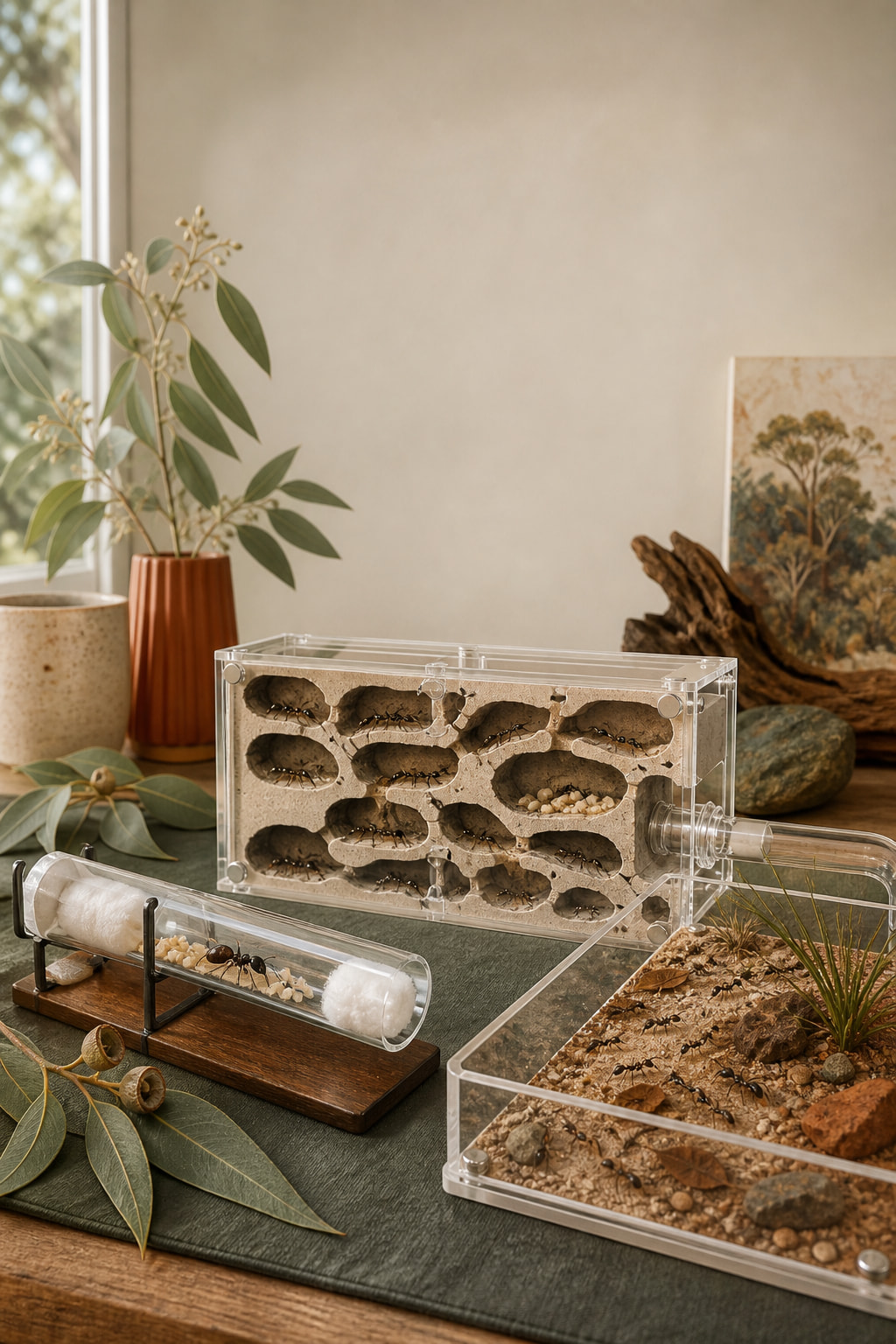
Chapter 2 gives you a practical mental model for reading the adults, brood, food sharing and signals inside a colony. Its three original illustrations are included in full.
Start with the calm, observation-led approach behind the whole guide.
Explore all 47 chapters, 18 species dossiers and 15 practical tools.
Learn the biology that changes feeding, disturbance, timing and preparation.
These are the contents of the complete handbook. Page numbers refer to the full 171-page digital edition, not this 11-page sample.
Ant keeping is a quiet craft. It rewards the person who notices small changes, resists unnecessary interference and learns to build conditions in which a colony can solve most of its own problems.
The appeal is easy to understand. A queen raises her first workers in a dark tube. Those workers begin to forage, feed larvae and organise their living space. A small founding colony becomes a busy society with its own rhythms, preferences and surprises. You can watch brood develop, see workers share food, study how they respond to weather and discover how differently Australian ants live.
The difficult part is that ants live in small enclosures and are easy to disturb. A keeper can act with good intentions and still cause trouble. Common causes include feeding or heating too much, moving a colony too soon and repeatedly checking a queen that needs darkness and stability. Good ant keeping depends less on owning elaborate equipment and more on making calm, practical decisions.
This book is designed to teach that judgement. It explains what to look for, what a colony needs, which problems demand action and which are best met with patience. It begins with the essentials, follows a colony from queen to mature nest, then builds the housing, problem-solving and species knowledge needed by an intermediate keeper. Bull ants receive their own advanced section because their excellent vision, activity and large size make them compelling. Their stings and the consequences of an escape demand a higher standard of preparation.
You do not need to memorise every page before starting. Use the guide as a route map, then return to the relevant chapter as your colony reaches each stage.
After working through this guide, you should be able to:
An ant colony is not a queen surrounded by identical helpers. It is a changing community made up of adults, developing brood, stored food, chemical signals and many different jobs. Brood is the name for the colony's eggs, larvae and pupae. Once you understand how this community works, many care decisions become easier.
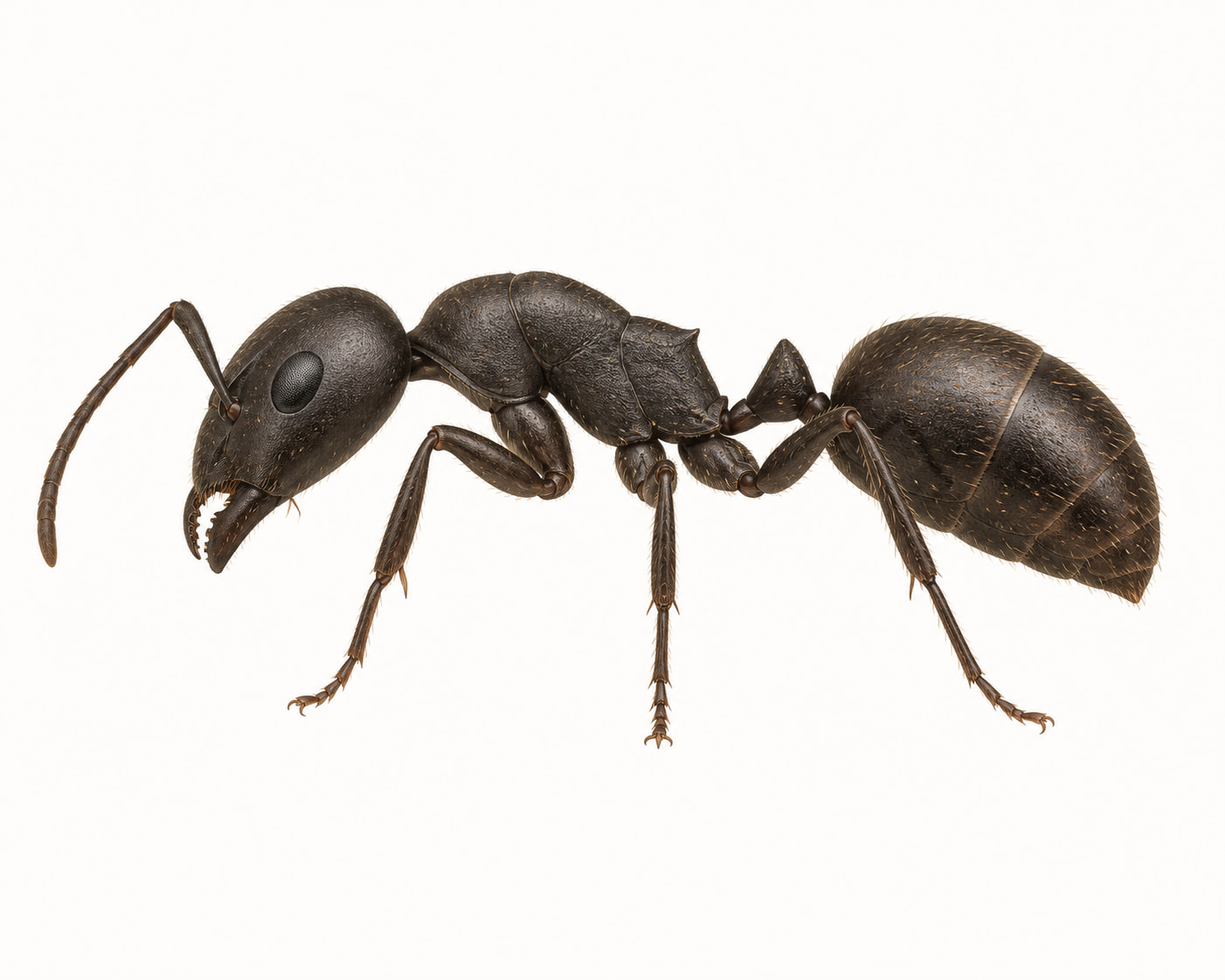
All ants are insects. They have a head, a middle body section called the mesosoma, a narrow waist and a large rear section called the gaster. They also have six legs and elbowed antennae. These features help you tell ants from termites and other lookalikes. Even so, ants from the same colony can look surprisingly different from one another.
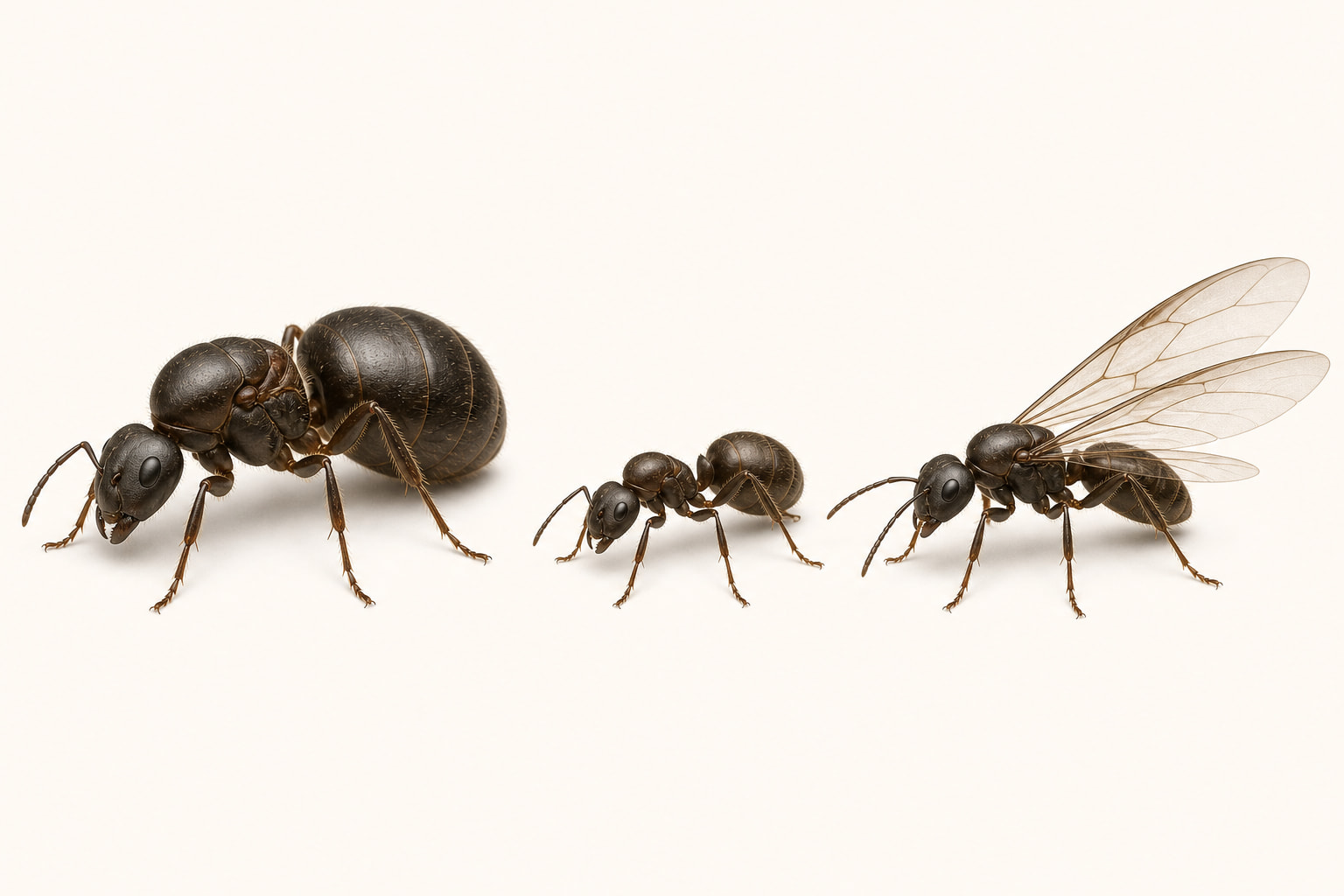
Workers are normally wingless females. They maintain the nest, care for brood, gather food, defend the colony and move materials. No ant gives them orders. What a worker does depends on its age, body, nearby signals, conditions and what the colony needs. In some species, all workers are a similar size. In others, worker sizes vary, and the largest workers may be called majors or soldiers.
Queens are egg-laying females. They usually have, or once had, wings, so their mesosoma is built to hold powerful flight muscles. A queen does not rule the colony or give orders. Her main role is to reproduce, and her chemical signals tell the colony about her fertility. Some colonies have one queen, while others may have several. In a few species, special workers called gamergates can reproduce. A species that can sometimes live with several queens is described as polygynous. Do not take this as permission to add another queen. Queens from separate colonies may fight, and success depends on the exact species and how the colony formed.
Males are reproductive adults. They are usually winged and are often produced during the colony's breeding season. Their body shape can be so different that a beginner may mistake them for another insect. They are not founding queens, and seeing males in a mature colony does not automatically mean something is wrong.
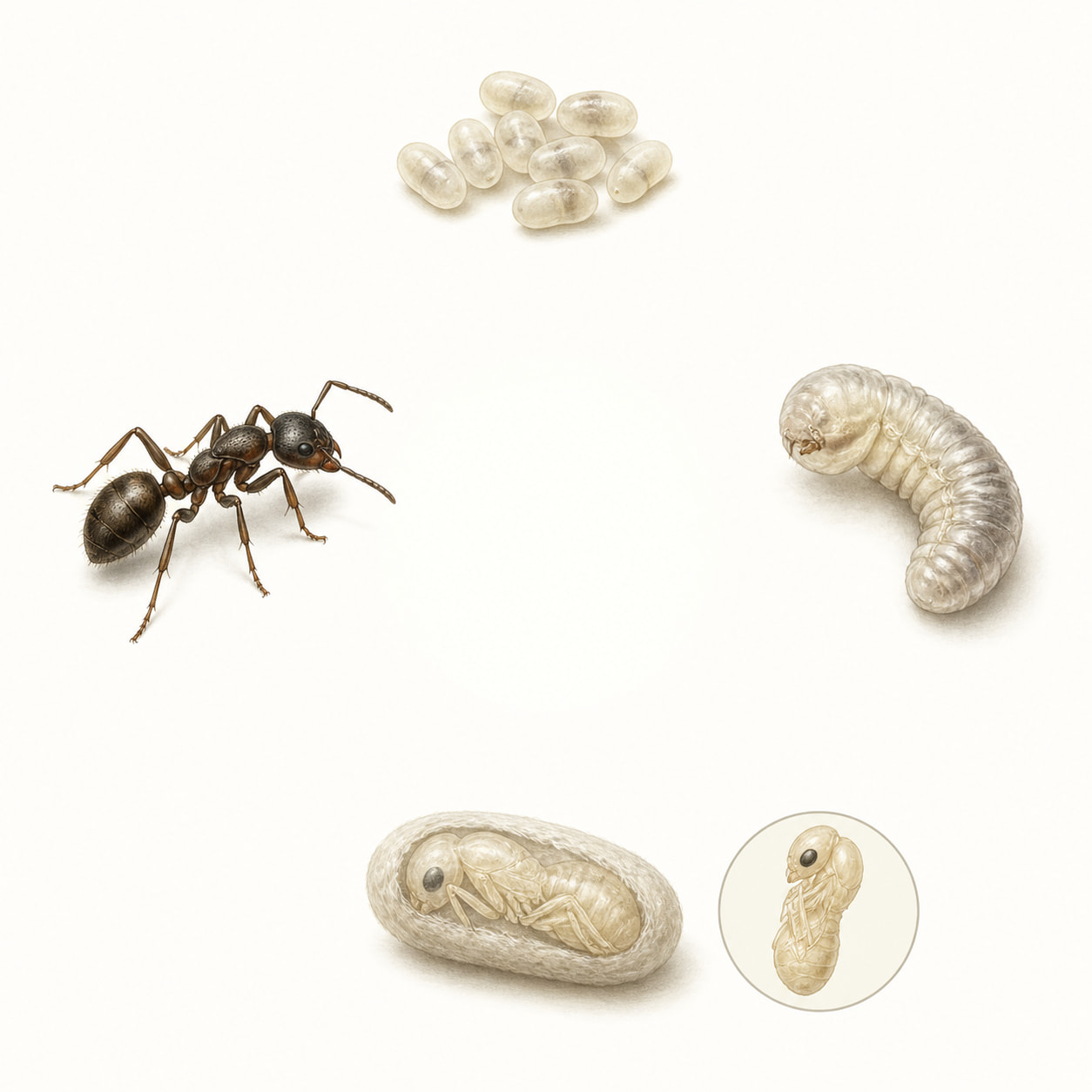
Ants undergo complete metamorphosis, which means they pass through four life stages:
A brood pile may contain several life stages. Eggs, small larvae, large larvae and pupae create different needs for the colony. A colony with hungry larvae may show more interest in protein than a colony with only eggs. Many pupae can mean that worker numbers are about to rise, so prepare safe feeding access before the new workers emerge.
Do not use this life cycle as a stopwatch. Development time depends on the species, temperature, food, colony condition and other factors. Even a useful estimate for the first workers should be treated as a range, not a guarantee.
Foragers do not eat only for themselves. In many species, adults share liquid food mouth-to-mouth. This is called trophallaxis. Workers may also carry solid prey to larvae. Feeding differs between species, so rules such as "all adult ants consume only liquid" or "all larvae need the same prey" are too simple.
Watch the colony, not just the feeder. Are more workers coming to the food? Is prey being carried into the nest? Are larvae placed near it? Is a sugary drop being eaten, drying out or becoming a drowning hazard? These signs tell you whether the food is useful and safe.
Ants communicate mainly through chemicals. Pheromones are scent signals that can guide nestmates along a trail or warn them of danger. Colony odour helps workers recognise members of their own nest. Touch, vibration and sight can also matter. Bull ants have especially good vision, but they still rely on chemical signals.
This helps explain why a small mistake can quickly upset a colony. Crushing a worker during feeding or cleaning may release alarm signals. Putting ants from two colonies together can trigger fighting. Constant vibration or repeated opening can disrupt normal colony activity. Work slowly, plan each step and keep the ants contained.
A simple way to think about a colony's life is in three stages: founding, growth and reproduction. During founding, the queen raises the first brood and workers. During growth, worker numbers rise and the colony expands its nest. A mature colony may produce males and new queens. These stages can overlap, and there is no worker count that marks the change for every species.
Founding also differs between species. Some queens stay sealed in the nest and raise their first workers mostly from energy stored in their bodies. This is called fully claustral founding. Other queens must leave the nest to find food. Some species start with several queens, split from an existing colony or use another specialised method. If you assume every queen is fully claustral, you may leave a queen without food when she needs it.
At each scheduled observation, note four things:
Use the answers to prepare, not to meddle. If you see many pupae, get the first outworld ready. The outworld is the feeding area outside the nest. If larvae are present but workers ignore fresh prey, check the food, disturbance, temperature and moisture. A queen with no brood may simply need more time. Your records will help you spot a pattern that is unusual for that species.
Beginners often give ants human motives. A queen may be called lazy or workers may be called disobedient. Brood may be described as abandoned when the workers have simply moved it to a different moisture level. These stories can be fun, but they do not help you work out what the colony needs.
Another mistake is treating every unusual feature as a problem. More than one queen, reproductive workers, bare pupae or large differences in worker size can all be normal for the right species. Better identification and species-specific information are more useful than one rule for every ant.
The complete 171-page handbook follows the colony through choosing, founding, feeding, water, housing, troubleshooting, mature care, bull ants, species dossiers and practical keeper tools.