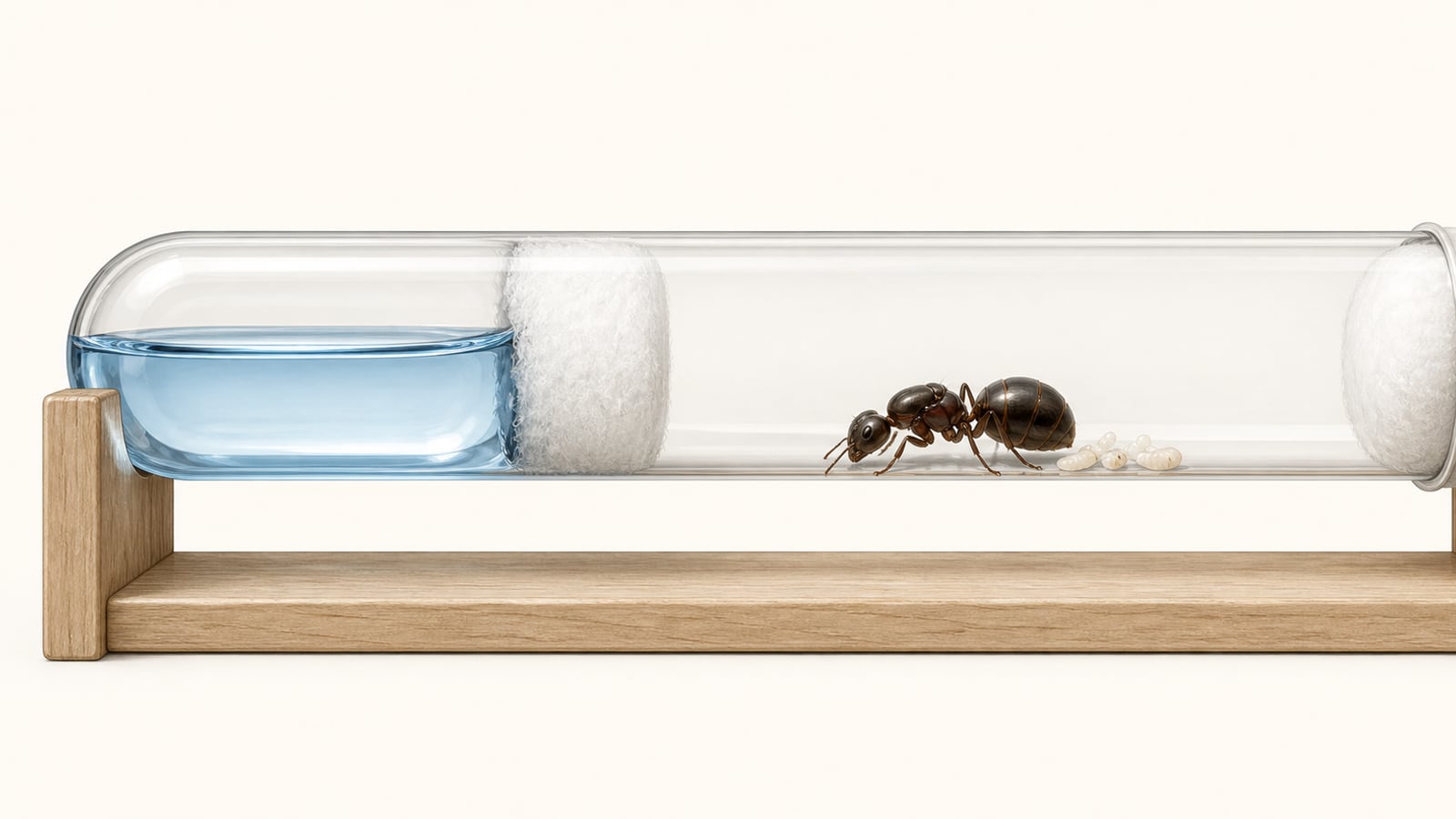
The short answer is: often enough to catch a real physical problem, and lightly enough to preserve the stable, dark conditions a founding queen needs.
That answer can feel unsatisfying when you want a timetable. It is also much safer than choosing a fixed number of days and applying it to every queen.
Species, founding strategy, water supply, room stability, season and colony stage all affect the right observation rhythm. A semi-claustral queen that must forage cannot be managed like a fully claustral queen resting on her reserves. A tube with a developing leak needs different attention from one that has remained stable.
Instead of asking for one perfect schedule, build a routine with three different levels of checking.
Level one: quick external safety checks
A safety check is not a full inspection. Its purpose is to notice whether the environment or enclosure may be failing.
Without opening the tube or unnecessarily handling the queen, look for signs such as:
- a tube that has rolled or shifted
- an insecure entrance plug
- water entering the living chamber
- a depleted or failed reservoir
- unexpected direct sun or another heat source
- severe or changed condensation
- damage to the tube, rack or surrounding containment
Also notice whether something in the room has changed. A moved blind, new appliance, slamming door or relocated shelf can alter heat, vibration and stability without anything changing inside the tube itself.
The frequency of these checks should reflect the setup. If the room and reservoir are stable, the check can remain very light. If conditions have recently changed, closer monitoring may be justified until you know the setup is stable again.
Level two: deliberate colony observations
A deliberate observation is when you briefly remove or lift the dark cover enough to assess the queen and visible brood.
Prepare before you begin. Use indirect light, keep the tube still and have your log ready. You should not need to open the entrance plug for a normal observation.
Check the same small set of things each time:
- Is the queen alive, coordinated and securely contained?
- Which brood stages can you see?
- Is the water reservoir intact?
- Is there any free water threatening the queen or brood?
- Has the cotton moved, dried or developed changing growth?
- Has the condensation pattern changed?
- If feeding is part of the confirmed founding plan, what was accepted or left?
- What else has changed since the previous observation?
Take a quick photograph from a similar angle when practical. Comparable images often show gradual development more reliably than memory and can reduce the urge to check again for reassurance.
Then replace the cover and leave the queen to settle.
Level three: intervention checks
An intervention is not simply a closer look. It is a response to a defined concern that may require a connection, transfer, food delivery or another controlled action.
Before opening anything, write down the observation that justifies it. Prepare the replacement tube, plugs, tools and secondary containment first.
This distinction matters because anxious checking often escalates. A keeper sees a mark on the cotton, opens the tube for a better view, decides the queen should move, changes the temperature and offers a new food, all before establishing whether anything was actually wrong.
When several variables change together, it becomes difficult to know what helped and easy to create a new risk.
What should change the checking rhythm?
There is no universal schedule, but there are useful factors to consider.
Founding strategy
A confirmed fully claustral queen generally benefits from stability and minimal disturbance while she raises her first workers from stored reserves.
A confirmed semi-claustral queen needs safe access to food. Feeding and waste removal create their own observation requirements, ideally through a very small, secure foraging space.
If the founding strategy is uncertain, do not assign it from queen size, wing status or appearance. Record the uncertainty and seek reliable species-level information.
Setup stability
A well-built tube with a sound reservoir, secure plug and stable storage location usually needs less intrusive attention than a setup with a recent leak, declining water supply or temperature change.
The goal is not to ignore a stable setup. It is to monitor it without repeatedly turning monitoring into disturbance.
Colony stage
Eggs, larvae, pupae and first workers change what you need to notice. First workers also change the escape risk and feeding routine. A plug that held a large queen may not contain her smaller offspring.
Recent warning signs
Repeated brood loss, poor coordination, persistent free water or a pattern of decline may justify closer investigation. One observation rarely supplies the cause, so compare it with the baseline and review recent changes before acting.
Do not turn brood into a countdown
Online timelines can make a healthy queen seem late when she is simply progressing at her own pace.
Development varies with species, queen condition, temperature, season and collection history. Eggs show that laying has begun, but do not prove fertility. Retained wings do not prove a queen is unmated, and shed wings do not prove that she is fertile.
Think in broad pathways instead:
- Stable founding: the queen remains coordinated, the setup is sound and brood is progressing at its own pace. Continue calm monitoring.
- Slow or paused founding: progress appears delayed, but the queen and enclosure remain stable. Recheck identification, founding strategy, season, water and room conditions before changing anything.
- Physical danger: flooding, failed water, dangerous heat, breakage or escape risk is present. Prepare a proportionate response promptly.
This keeps your next action connected to evidence rather than someone else’s calendar.
Make every check earn its disturbance
A one-line log is often enough:
“Larvae still visible; reservoir secure; no free water; queen coordinated; no change.”
That entry gives you more useful evidence than “looks fine”. It also creates a clear end to the observation.
Before checking again, ask yourself:
- What specific condition am I checking?
- Can I see it without moving the tube?
- Has anything changed since the last observation?
- Would another look change what I do?
If the honest answer is that you are checking only to relieve uncertainty, leave the cover in place. The uneventful days are often the days in which the queen is doing exactly what she needs to do.
Safety note: Normal observation should not require opening an occupied tube. When opening, feeding or connecting equipment is necessary, place the entire setup inside secure secondary containment and prepare every tool first. Unknown, fast or stinging ants require extra caution and may need a specialised approach.
Learn what to watch, not just when to look
A calm checking routine is one part of successful founding. Identification, founding strategy, tube construction, feeding decisions and interpreting brood all affect whether your observations lead to good care.